
Bulgarian start-up Imagga has developed what it describes as “Powerful image recognition APIs for automated categorizations & annotation of visual content.” Using the APIs a user can upload an image and then be instantly presented with a series of relevant “tags” that can then be attached to the image metadata through clicking on a series of icons.
From testing out the API here (try it yourself!) it is clearly very powerful.
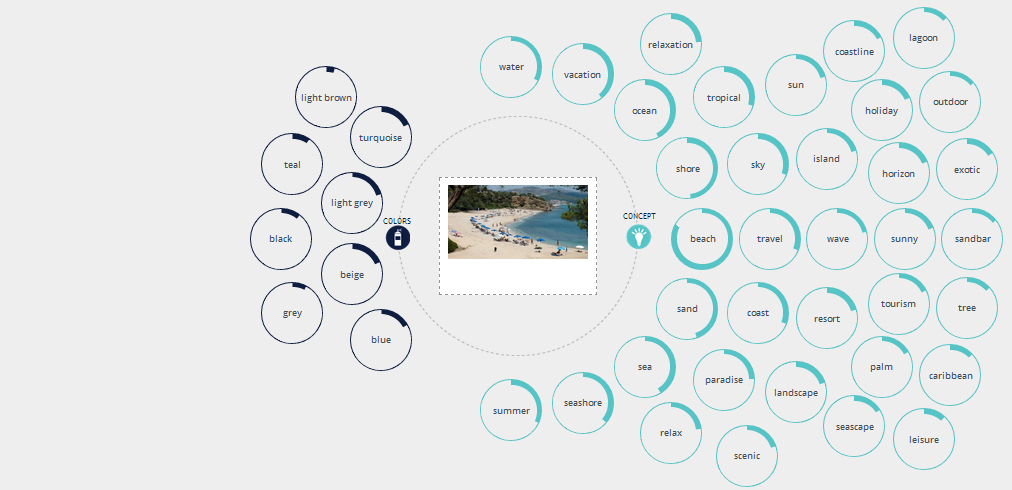
As can be seen above – upon processing the image, an array of image tags are presented to the user as a series of circles, with those arranged closest to the image proposed as the most relevant. The tags are split in to two typologies – “colors” and “concept”. What is arguably the most impressive aspect of the technology is the accuracy in the APIs to detect relevant and useful concepts as a consequence of image content for any image.
When trying out the image below through the API, it was able to recognise that the people within the image were men, “attractive” (I will leave that to readers to decide), as well as noticing “hand”, “adult” “people”. “studio”. Quite hilariously it does mistake a drink for an “oboe” – however with tags being verified by the user these suggestions would not cause a problem. Theoretically the API could also be taught to “learn” through use which tags are more accurate through selection and become more powerful as it becomes more widely used.

Not too far from an oboe
The Next Web reports that in addition: “Imagga’s technology covers not only proprietary image auto-tagging, but also auto-categorization, color extraction/search and smart cropping.”
Imagga has proposed that the technology would be most useful “If your business model relies on monetizing crowd-sourced images” – i.e. in professional workflows where meta-data and tagging are critical tools.
However much could be said of implementing such technologies in consumer-level social sharing.
Why is it important?
Innovation rarely occurs unless an opportunity to solve a perceived problem has been identified. In this case Imagga have developed the above APIs to cater for a significant deadlock within the professional imaging work flows due to the sheer amount of time required to categorize large groups of images.
Historically, photography companies (or those that work with large quantities of images) would not have had to deal with the sheer volume of images that are created today. The increasing amount of images has also led to an increasing amount of a particular kind of photowork – making sure that the image is correctly organized and retrievable from descriptors.
In current work flows this would equate to a massive amount of work by either: entering tags for each image individually; or, entering tags for groups of images at a time and losing the specific descriptors of each image.
The use of API proposed tags (if adopted widely) also intrinsically standardizes the terms used to describe similar images – which could ultimately make tag-based searches more effective. In addition Imagga has developed a streamlined UI which allows this categorization to take place far easier than ever before (without having to open individual menus etc), significantly cutting down the time required to complete this work.
The technology displayed by Imagga represents an important step in acknowledging the significance effectively using meta-data as a part of digital imaging practices.
How might it affect the Social Camera?
Consumer imaging and the emergence of sharing as photowork
As a consequence of innovation, practices have emerged in consumer imaging that were not present in film-based photography. These centre around how we share and engage with images (both publicly and privately) within digital spaces.
The economy of consumer imaging is now based on the exchange of increasing amounts of digital images. These – as with film in the past – can serve as mementoes of our past for later recollection, tools for developing social relationships as well as a means of constructing a personal expression of identity.
A critical issue with ongoing innovation however is that it appears that consumers are lacking the tools to be able to: effectively engage with the increasing volume of images they are creating, share them successfully in public streams, or efficiently navigate those being created by others.
Metadata attached to a digital image can be helpful tool to categorize images for easier navigation and discovery. Some useful information is automatically encoded into the image file when we create it (camera used, imaging settings, time taken and even location taken in some cases). In addition an unlimited amount of additional tags can also be attributed into an images’ metadata, allowing the prospect of users being able to search their images on the basis of selected criteria.
At the consumer level (where image production is expanding the most) leverage of metadata in this way, to help users is not common practice – and where found is time-consuming and expertise driven when compared to other streamlined and automated processes.
The example of Instagram
Instagram’s sharing economy is vastly improved by the use of user assigned hashtags (#). Here images with hashtags can be easily found through user-inputted searches. This form of tagging works broadly on the same premise as metadata mentioned above – but here the tags are primarily employed as a means of distributing images. (The hashtag can also be seen to have a communicative function).
The issue with this as a practice is that compared to image capture the interaction required upon the part of the user to share is fairly laborious – and requires knowledge of appropriate categories to tag images with in order to reach desired audiences. In this way the automated technology offered by Imagga (or similar auto-tagging APIs) could find profound use on Instagram where images are tagged and entered into curated streams automatically based on the content of images. (The API and UI could also be used to present the user with a series of relevant suggested tags, which they could then tap to include with far less friction than the current method.)
Imagga and Instagram - a match made in heaven?
With many users “off the grid” of discovery by sharing without hashtags (sharing only to their followers) the impact of an automatic content based API could greatly benefit the image creator who presumably would – with little effort – find themselves enjoying increased volume of engagement around their images as they are being distributed publically.
In addition it could potentially structure Instagram’s image discover functions so that increased diversity of users are included, as well as structuring the content contained on the platform by a set of API standardized categories. This would mean that accurate navigation of other people’s images would not be reliant on understanding the user-determined “culture of hashtags” being used to describe images. The main issue with this however would be the loss of an idiosyncratic dimension to Instagram where social interactions take place over unique community driven tags. Many of these can be seen to benefit Instagram as it characterises the growth of unique trends on the platform.
However there could be some argument to include automatic image categorization alongside user-inputted tags to retain this on the platform to offer the benefits of both.
Imagga highlights the emerging important of effective sharing as a practice in its own right within consumer imaging – where there is a critical opportunity for innovation to intervene and create value in practices of sharing that have so far been ignored
What do you think though? Leave a comment or start a conversation with me on Twitter at @mdhendry


 Martin Douglas Hendry

Leave a reply to Chris (@chrisgeorgiev) Cancel reply