SUSAN SONTAG: ON PHOTOGRAPHY
Susan Sontag‘s 1977 book “On Photography” is home to some of the most widely cited thinking in the field. It remains a solid overview of the field nearly 40 years after it was first published.
The 1st chapter is an essay called “In Plato’s Cave”. It contains some of the best insight in the book. So, lets take a look at 5 things Susan said, and what it can tell us about smartphone photography.
Susan Sontag
5 QUOTES THAT TELL US ABOUT SMARTPHONE PHOTOGRAPHY
[1] “Photographs alter and enlarge our notion of what is worth looking at and what we have the right to observe. They are a grammar and, even more importantly, an ethics of seeing.”
Through making and sharing photographs, we collectively decide the kinds of things that should be recorded.
Photography also captures *how* look at things.Through sharing we also establish boundaries to how we should see the world around us.
This is like a “free-market” of photographic ideas. Images with the best content and perspectives become more popular (either in art, adverts or otherwise) and influence others more.
Social media has super-charged this, with new trends popping up and sticking faster and faster.
So when all of a sudden people are obsessed with ‘selfies’; is everyone actually agreeing to see the world in a different way?
[2] “To collect photographs is to collect the world… Photographs really are experience captured, and the camera is the ideal arm of consciousness in its acquisitive mood.”
Taking photos is like collecting important bits of your life (e.g. special objects, people, places and events).
But, instead of the thing itself, you get a photograph. It’s a lot easier to collect, carry and share things this way…
Smartphones are now the most popular cameras on the planet.
Instead of collecting experiences mostly for ourselves as in the past. The lion’s share of images we create today are now made for sharing online…
So, how much does the knowledge of an outside audience influence the things we ‘collect’, and how we collect them?
[3] A photograph passes for incontrovertible proof that a given thing happened. The picture may distort; but there is always a presumption that something exists, or did exist, which is like what’s in the picture.”
Even though a photo can be manipulated (a lot)- it can’t be entirely made up!
This makes photos, even highly edited (or really weird ones), believable on sight to most people. Because they say *something* about reality that was in front of a camera.
How we present ourselves online relies on *some part* of the image saying something true about us and our experience.
But do we push this to the limit using: high-angle shots, filters and tools; to craft the best version of ourselves to share?
[4] “By furnishing this already crowded world with a duplicate one of images, photography makes us feel that the world is more available to us than it really is.”
Photographs present us with the appearance of things.
For everything in the world (objects, people, places, events); there seems to be an photo we can look at.
It seems to bring close to us; things from the past, or which are far away. The “closeness” these images is an illusion; and actually hides the fact that these things are actually far away.
Social media seems to collapse the boundaries between friends far away. In reality, we tend to be alone when we’re online; either at computers or staring distractedly into our smartphones.
Is the “closeness” we get from sharing photos actually distracting us from the fact we’re becoming more isolated in reality?
[5] “A way of certifying experience, taking photographs is also a way of refusing it – by limiting experience to a search for the photogenic, by converting experience into an image, a souvenir.”
When we take and share photographs; we’re certifying that things which are important to us exist.
But at the same time we’re ignoring a whole bunch of things in our lives that don’t make “the cut”.
We can’t take pictures of *everything*. Photography is a judgemental practice because only “photogenic” things are recorded.
This is a bit like [1]. The way we see things becomes limited to things worthy of photographing, and the rest is ignored.
When it comes to smartphone photography, we’re even *more* discerning – because images must be interesting to others too.
How much of our life actually makes “the cut”? And how much of us is hidden from others because it didn’t make a good shot?

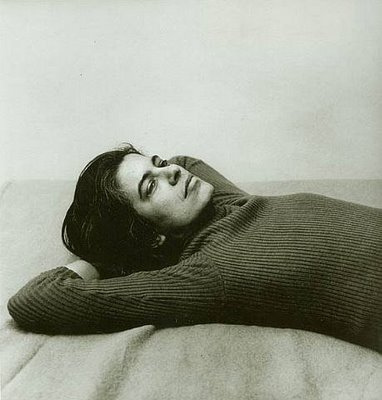
Here is a picture of Susan Sontag by Juan Bastos
Takeaway
When I first read this chapter, I found around 25 quotes I wanted to use. But if you’re anything like me, 5 was more than enough!
The overall theme from the insights is:
Smartphone photography brings a larger audience to our images. In the past we used photography to record our story for reflection, and then share.
Today our story is often written, (and reflection happens) in front of friends, family and public – as we go along. This adds a lot more pressure to what we record.
Is this a good thing? Or do we now filter what we shoot and share for others so much, that our photos don’t tell us as much as they used to?
I could go on and on (don’t worry I won’t!) But what do you think?
If you haven’t read On Photography, pick it up from Amazon here. If you have – are there any insights I’ve missed that need mentioning?
Let me know.
Feel free to spark up a conversation on Twitter: @martinsaidthis
 Martin Douglas Hendry
Leave a comment