iPHONE: A LEGACY IN PHOTOGRAPHY
Over the last couple of generations, Apple’s ad campaigns for new iPhones have focused on the camera. This is really smart because, unlike others, Apple don’t dwell on the technology. They talk about what users can do with with the technology. (Only nerds like me are *really* interested on what’s going on inside!)
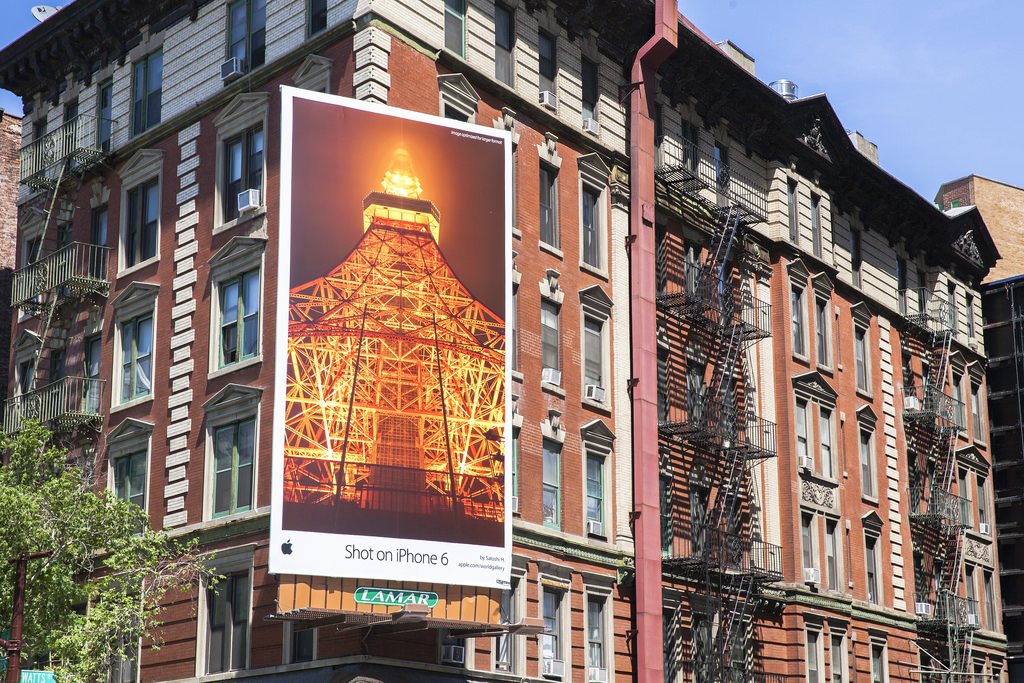
Turns out, the camera is really useful in telling the enticing story of an “Apple person”. The images shown on billboards, or at the keynote reflect an ethical, exciting and vibrant lifestyle. It’s the kind of lifestyle *you* could capture and share…
…if you buy the new iPhone.
This is meaning-centred design and marketing 101. It’s also smart business; because whilst other parts of the iPhone have been hard to improve (e.g. battery life, goddamit!) – the camera has improved considerably over successive generations.
If you’re interested in these differences – there’s a fantastic comparison on www.snapsnapsnap.photos which goes into more depth than here (image below).

You can see this on Flickr’s camera finder, not to mention across social media, where the majority of photos we create today are shared. (Android’s larger market share is, itself, shared across thousands of handsets). Whether you like it or not, we take a lot of photos using smartphones – and particularly iPhones.
But with iPhone 7 and iPhone 7+ around the corner – and apathy towards ‘live photos’ offered in the last generation – can Apple revolutionize photography again?
1 BECOMES 2
Some clues have come to light in recent weeks.
A number have sources have reported leaks purportedly showing what the forthcoming iPhone 7 and iPhone 7+ (or ‘Pro’) look like. Both sport new rear cameras; and in the case of the iPhone 7+ is looks like it actually has two cameras on the back!

Spoiler: no.
Two smartphones have been released this year with 2nd cameras; albeit for different reasons…
SOMETHING OLD, IN SOMETHING NEW

The first was the Huawei P9, whose camera module was developed with Leica – a legendary lens and camera manufacturer (please feel free to send me the new M9 for this endorsement). The Huawai combined a 12 MP camera with a 2nd, 12 MP monochrome sensor.
But what does this extra camera do exactly? Three things apparently.
First and foremost, the 2nd camera adds more detail to your pictures, by stitching the best parts of the two images together:
“Capture more light with two sensors… Get incredible shots with the Huawei P9’s merging algorithm, which intelligently combines the colours take by the RGB sensor with the detail of the monochrome sensor”.
Secondly, monochrome sensors can take in more light than colour sensors. This can improve low-light performance, which is an annoyance for many smartphone users (especially those in ‘the club’).
Finally, the improved performance helps you achieve “professional photographic effects” like: wider aperture (more bokeh!!!) and a dedicated monochrome mode.
So, in the case of the P9; the 2nd camera essentially ‘superpowers’ the main camera, bringing it a step closer to a level “professional” quality and control. Neat.
But that’s not all a 2nd camera might do…
THE BIGGER PICTURE
The LG G5 is something else. Aside from the camera (we’ll get to that in a sec) it’s the first smartphone to go modular. The idea behind this is that instead of buying a new phone every two years – you update individual parts – like you would software.
The G5 is ambitious across the board in the innovations it brings to the table, including – you guessed it – the 2nd camera.

Unlike the Huawei however, the 2nd camera isn’t there to boost the overall quality of your shots – it’s about offering something different…
The second camera has a wide-angle lens – allowing users to quickly select between two different shot styles.
For the uninitiated, wide-angle lenses capture a wider view . It means you can fit more people in your group shots; or a broader, more dramatic landscape.
Wide angle lenses also allow more light in – meaning you can *usually* capture good images with less light than standard lenses.
So the LG G5 ultimately offers more creative options for smartphone photographers (and videographers!) who can switch up the look of their shots with a single button press. Also neat.
APPLE’S NEXT MOVE?
But which is more likely for the iPhone 7+? Both offer clear improvements over the current generation. Or, could Apple’s take offer something different entirely?
Apple will be aware that a wayward feature might impact to their claim as kings of smartphone design. So it’s important that even though they might not have got their first – that they get it right.
Their acquisition of LinX for $20million may offer an insight. LinX develop sets of sensors that aim to rival consumer SLRs. So, like the Huawei, the function may be to improving the main camera’s images. But… we’ll just have to wait and see.
Whether the iPhone 7+ offers different lenses, or simply superpowers the one it already has – duel cameras are coming, and they’re here to stay.
Now, how long until duel selfie cams?
What do you think? Leave a comment below or tweet me @martinsaidthis
 Martin Douglas Hendry
Leave a comment