Firstly I would like to apologise to those of you – aside from myself – who read this research blog for the lack of activity over the course of the past few months. Whilst this blog is primarily a means for me to record what I see as significant emerging innovations in image-sharing.
Over this time I have found myself working on other projects and the data-collection phase of my research. Whilst I will be not getting any less busy over the coming year (the opposite in fact) – I am going to make time to post here in a more, even if this means that the posts themselves will be less substantial. With sights set firmly on 100 posts by Xmas – let’s go.
What is it?
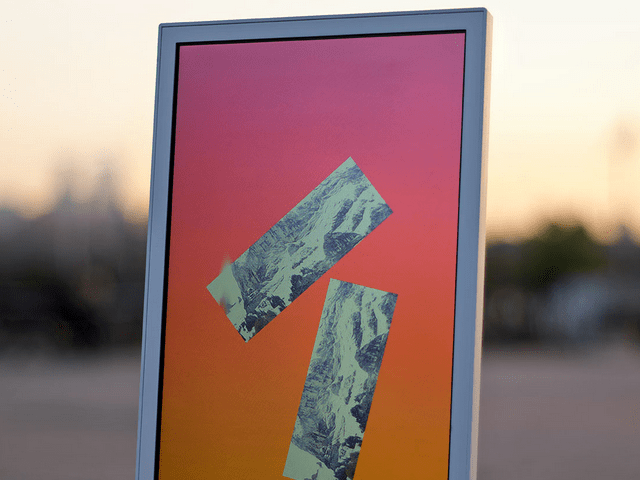
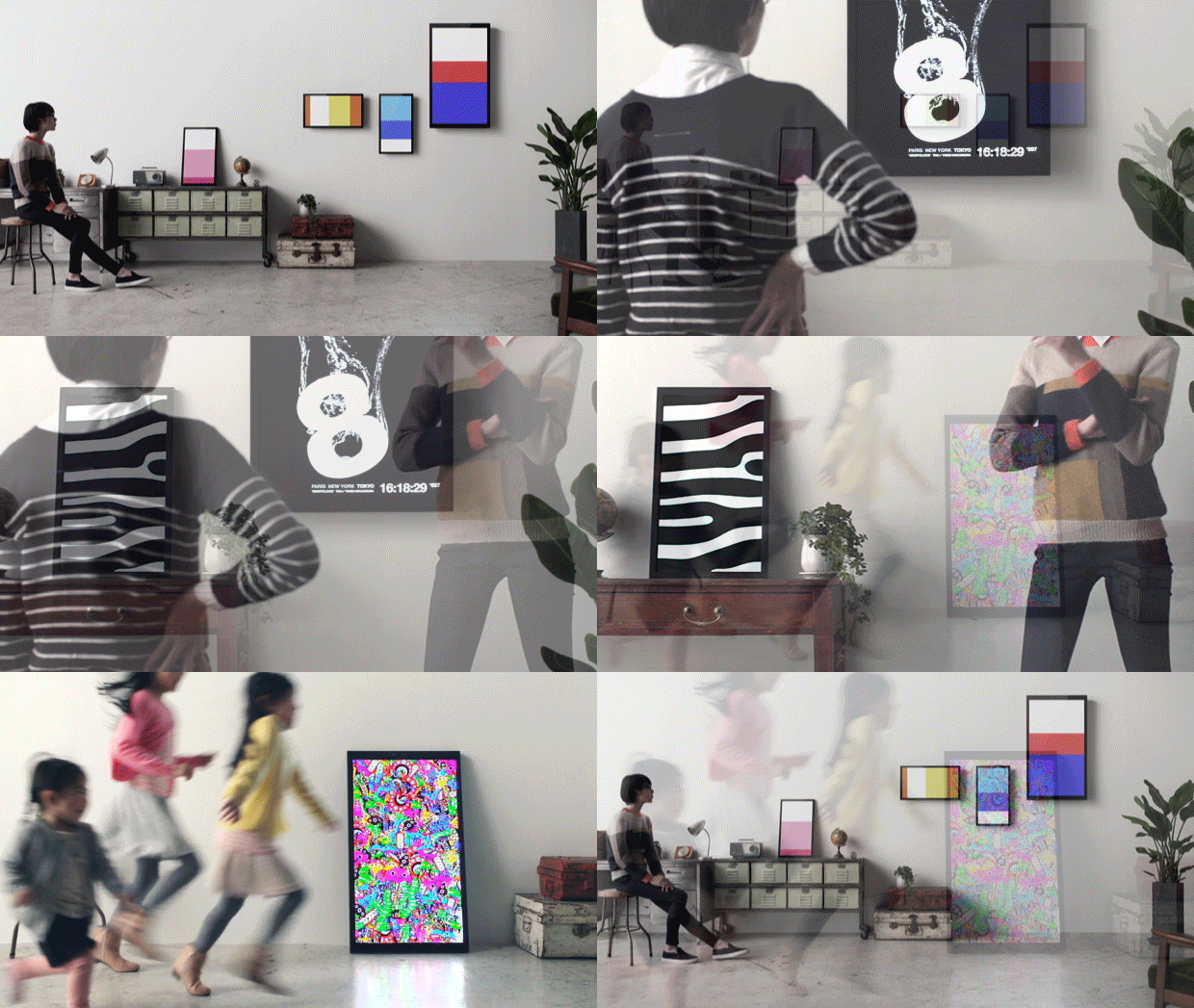
“Framed” and “Electronic Objects” are two recently successful projects on Kickstarter that sought funding for a digital art platform and display. In both cases this platform consists of a digital screen that is placed within an environment (typically the home) whose primary function is to display visual digital art.
Aside from this hardware both platforms also consist of a smartphone app that interfaces with the screen, allowing users to transfer digital files to the screen for display. Both also offer a proprietary “art store” where people who have purchased the display are able to pay a premium for work that has been created specifically for display on the device.
It can be assumed that alongside an increase in the interest of non-photographic digital artworks, that the displays can and will be used to display photographic work.
Why is it important?
Digital displays are nothing new, and when it comes to photography digital photo frames have sold reasonably well for nearly as long as digital cameras themselves. However, the overwhelming support behind of both of these projects on Kickstarter (both have surpassed their funding limit several times over) suggests a gap has been filled in the logic. As such this begs the question we must ask the question: “why has this become such a big deal now?” And what is it exactly which differentiates these displays from digital photo frames (or digital screens in general).
One reasoning might follow that digital photo frames during the digital upheaval became – like the requirement to print all digital photographs – redundant. During the transitions from chemical to digital images we found ourselves consuming the latter through “active” digital displays (computers and then our phones). This meant that the digital photo frames were not a requirement for users of digital imaging because:
Digital photo-frames are passive displays and did not offer the abundance of interactive features all of a sudden found when displaying images online. This is where the image became truly “social” as photographs taken by people became a fulcrum for social interaction rather than an object used primarily for self-reflection.
Digital images in digital photo frames at the time offered nothing more than “regular” photos in that context – and may even have suffered in comparison in quality (the value they offered users as mementos or keepsakes.)
Bearing this in mind – two significant reasons could be behind renewed interest in these kind of items now:
A) The first being the maturation of other forms of digital visual art which need to be displayed as such (alongside photography). Only now is this feasible as visual digital media (not necessarily photography) has matured to the point where a dedicated digital display is desirable in the home (?)
And
B) The notion of revisiting personal or non-shared media.
These will be discussed briefly in the following section in relation to “the social camera”.
How might it affect the Social Camera?
The Importance of Multi-Modal Media (Again)
In the previous blog post – some time ago – we talked about the idea of multi-modal media and the convergence of media forms.
To paraphrase that whole conversation, this basically meant that there is a mounting tendency for all sorts of different media to be displayed alongside each other. This is a result of all digital (or new) media being comprised of the same underlying material – binary data.
As a consequence of this we have become accustomed to engaging with media in a multi-modal context rather than distinctly. Where before we would be far more aware of the difference between motion film and photography (as a consequence of their unique format and tradition); today, the differentiation is now much more difficult to make. In social media at least, moving images and first-hand photographs (+ memes, and digital artworks) are being produced, shared and consumed in very similar ways and places. This we can consider to be a consequence of media convergence.
Without entering the minefield of defining what a photograph exactly is in the digital age (yet) – we can state within reason that there has been an increase in the production and consumption of visual media at a fundamental level. As a consequence of this, we have become better at producing visual media and critiquing it, and have developed increasingly powerful tools to do so.
As a consequence we are engaging with visual media of higher volume, types and of increased “quality”. As a consequence a threshold may have been met which makes the use of a passive digital display more feasible.
Although there is something to be said for the fact that the artworks previewed by the display companies featured responsive artworks. With something like the Lytro camera – it would not be surprising to see light field photography thrive on this kind of platform in the future…
The Not So Social Camera
This blog (and my research in general) draws upon the hypothesis that photography has become an intrinsically social activity – with the ritual of creating and recording media for oneself something that we have drawn away from as a culture. However there is something about the idea of a digital art frame however (in conjunction with an “art store”) that refers to existing ideas of exclusive ownership. Which is pretty much the antithesis of this concept.
In this way, the popularity of FRAMED and Electronic Objects may be a result of a desire on the part of the individual to grant a physical presence to the ephemera of digital media found on-line or elsewhere.
Whether this is the case remains to be seen – but it would be interesting to see whether we are witnessing a resurgence of photography for the self (as opposed to for social transaction and sharing). This idea will be fleshed out more when I have the time to revisit it. More soon…
(This blog will be rewritten completely over the coming days, just wanted to make sure that I captured my thinking in it’s rawest – and sadly most incoherent – form.)
 Martin Douglas Hendry
Leave a comment