

Introducing the Raspberry Pi-powered OTTO GIF camera
What is it?
The Otto camera is a Raspberry Pi powered “GIF camera” which began seeking $60,000 in funding from the 15th of May 2014. As of writing the call for funding has been online for 4 days and has received $27,000 of this amount. As a camera it is quite unique in that the images that it captures are encoded as GIFs then which can then be accessed (and shared) via a synchronized smartphone.
In order to capture its unique type of images the user turns (what would be on a film camera) the winding mechanism clockwise. Doing so, the user is able to stop and readjust the subject or framing (e.g. as below), creating as long a GIF as they desire. When the image-creator is happy with what they have captured, they then wind the mechanism one full turn the anti-clockwise to “complete” the GIF. This can then immediately be reviewed and shared from the synced smartphone.

Are these the kind of images that we’ll be sharing in the future? If so why, or why not?
The camera purports to be the first commercial product powered by the open Raspberry Pi computer system which – along with a hacker-friendly SDK, afford the user a great degree of customization, and the ability to develop (and share) their own pre-set capturing and exporting “modes”.
“MODES are what makes OTTO different from every other camera. Modes are like tiny apps that define how OTTO makes pictures. In other words: modes change what happens when you press OTTO’s shutter button or turn it’s built-in crank.
OTTO ships with a library of built-in modes to do fun things like shoot animated GIFs, or set up an impromptu photo booth. Using your smartphone, you can change between any of these built-in picture-taking modes, or pick user-created modes from the in-app MODE GALLERY.”
The degree of customization is something that the company behind the device place at the forefront of its appeal – presenting it as a dynamic device which is able to adapt to your demands upon it. In this way, the camera itself does not stand alone, but is also capable of utilizing and displaying information from additional sensors, such as those within the smartphone (examples below being location and noise information then being displayed in addition to the image).

Here a number of “modes” are shown outlining the possibilities offered by the SDK. Of particular note is the bottom right panel, which superimposes location information on top of the image.
This flexibility has been explicitly made as accessible as possible to lay users – rather than only those capable of coding the Pi – through a robust user interface. Once these “modes” have been created through the smartphone, they are automatically synced to the device itself from where they can be instantly uploaded.
The developers explicitly state that they have based the design of the camera on “the kind people half-jokingly refer to as ‘real’ cameras — Leicas, Rolleiflex, Voigtlander, and especially the humble Holga.” The influence of the latter is clear, in both the form factor of the device which resembles the iconic Chinese toy camera, as well as the playful nature in which it is intended to be used.
Interestingly enough, the camera turns the film winding mechanism into the capture mechanism (which arguably might make it difficult to view through the optical viewfinder when capturing). However, it also features a circular 96 x 96 OLED display on the top of the device – which allows for more practice vertical viewfinding – similar to the infamous Kodak Brownies.
For reference, additional hardware details are reported as follows:
“OTTO is powered by the Raspberry Pi Compute Module, with a Broadcom BCM2835 SoC. That’s a 700MHz ARM 11 core, with dual core video co-processor and 1080p30 native H.264 hardware encode/decode, advanced Image Sensor Pipeline, 4GB on onboard flash memory, USB 2.0, and lots of other goodies.
Image capture is done though an f/2.0 35mm equivalent optical glass lens onto an Omnivision OV5647 5 megapixel ¼” 1.4µm backside illuminated pixel CMOS sensor, capable of images up to 2592x1944px, HD video up to 1080p30 / 720p60, and VGA 640×480 at 90 frames per second! We think it’s quite a little powerhouse.”
However, critically, the OTTO proposes two crucial innovations that I will now discuss. Firstly the fact that it exports GIFS proposes a continued collision of meme culture and first person image-creation – and secondly, it is arguably the first consumer camera (aside from smartphones) that features modular software as a critical functionwithin the device. These points will be discussed in further detail below.
Why is it important?
The OTTO – whilst currently a V1.0 device seeking funding on Kickstarter – is also proposes an interesting shift in scope (using existing technologies) in what we might consider a camera to be in the future. In this case, there are two main attributes to discuss.
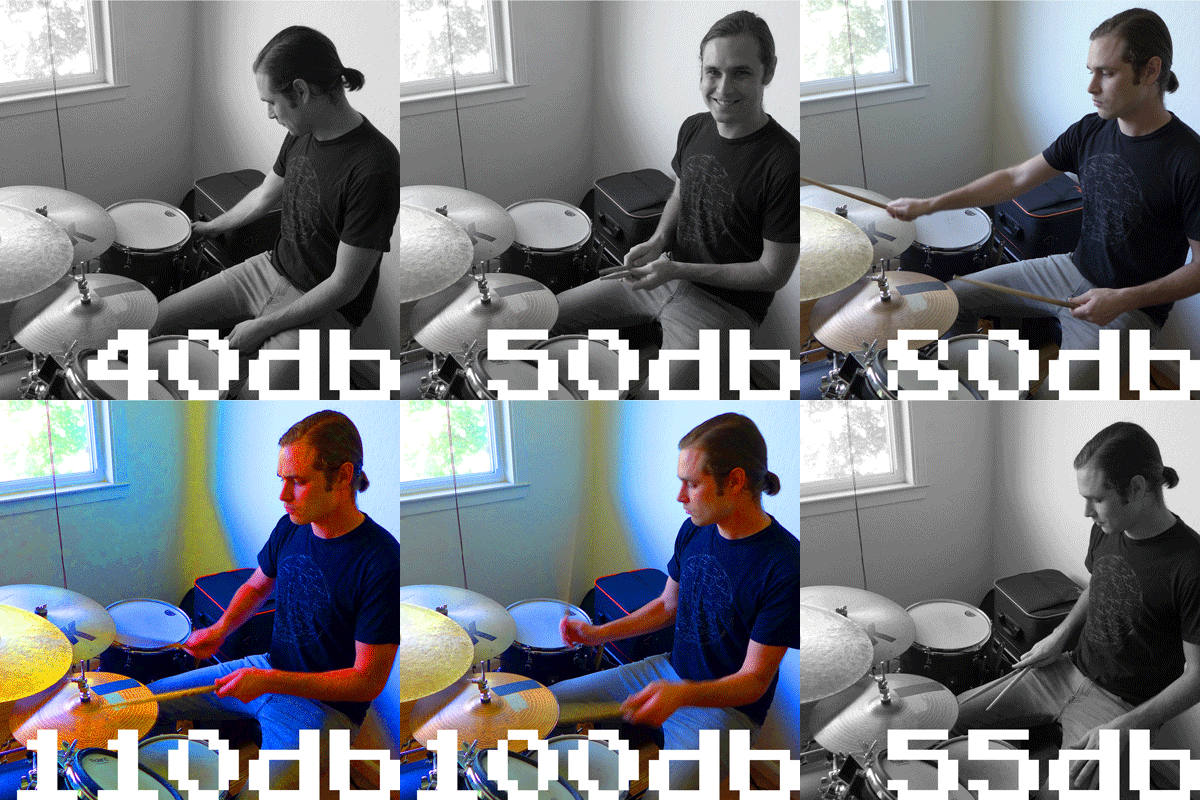
Here a mode has been created not only to visually display volume on screen, but to also change the saturation of the output in relation to it
The Significance of GIFS and Emerging Image Cultures
That the OTTO camera exports its images as GIFs is significant. Today our smartphone cameras are capable of exporting both images (typically JPEG) and video (typically MPEG4). A GIF exists somewhere between these two distinct forms – as it is neither strictly (though it can be) a static image, not a movie.
In relation to the latter, it can be considered far more “light-weight” in both file size, and ease of distribution. As a consequence the GIF has become a medium of expression which is being used distinctly from both static images, and movies. Of particular note are the use of short GIF clips in comment chains (often depicting people’s reactions) on sharing communities such as Reddit and Tumblr.
Crucially however, the majority of these GIFs tend to be sourced from secondary media – and are not captured by the OP (original poster). This is typically seen with movie clips, aswell as short GIFs extracted from YouTube videos (these appear to be “first-hand” media, but for the most part have been selected and converted into a GIF by a secondary actor, once the original video has become popular or of note). Without a device such as the OTTO would typically be the requirement for the GIF creator to record the instance as a video, then convert a section of it into a GIF for sharing in this way.
As such – there is very little precedent for sharing “first-hand” GIFs, albeit an infrastructure and existing culture of sharing where GIFs created using the OTTO could coexist with existing media. Crucially, however, this a completely novel workflow, for both image-creators and GIF sharers (albeit one that seems to have been considered in depth by the developers of the OTTO device).
Evolving Hardware Through Software
Another significant attribute of the OTTO camera is that it is the first – of my knowing – camera since the emergence of smartphone platforms (iOS, Android, Windows Phone etc.) that explicitly invites users to modify it limitlessly to fulfill their requirements of it.
In smartphones, this occurs through the selection of a range of image applications (and workflows/performances) where a user is able to customise how they create and share images in a number of compelling ways. Crucially, this (subject to hardware limitations) allows the device to “evolve” alongside cultural expectations upon photography as a practice.
In the OTTO this platform is not an “app store” but rather an SDK (software developer kit) based on the Raspberry Pi system which allows users massive freedom in modifying the output of the device. In addition to this (as previously mentioned) – the device is also configured in order to be accessible to lay users with a “mode” where users can explore and utilize popular “modes” uploaded by the community – as well as upload their own. In addition, a number of generic modifications can be accessed through the smartphone itself.
Crucially, this stands as evidence of a concern for the technology itself to become maleable or reflexive to its culture of use, rather than the other way around.
We could argue that previously technology had more influence in defining photographer (as a consequence of its rigidity, and common workflows/performances). Now, we find that – should reflexive and accessibly hack-friendly cameras like the OTTO become widely adopted that this causality might be turned on its head.
How might it affect the social camera?
To conclude – the OTTO camera is significant for two primary reasons (which will be even moreso should the device, or similar become ubiquitous):
1/ It represents a technological validation of GIF culture (existing somewhere between static images and video) – and proposes to introduce the possibility of capturing and sharing “first-hand” material in a seamless and intuitive way.
2/ It represents the first in a second wave of hardware which is able to adapt through software choices to user demands upon it. The first of these were smartphones which epitomise the plurality of social photo-sharing practices today. Where before we might argue that photography has been defined by largely “stable” devices and workflows – reflexive and dynamic cameras such as the OTTO (and ergo smartphones) may in fact adapt to photography through the evolution of this software to user demands (and their use.
 Martin Douglas Hendry
Leave a comment