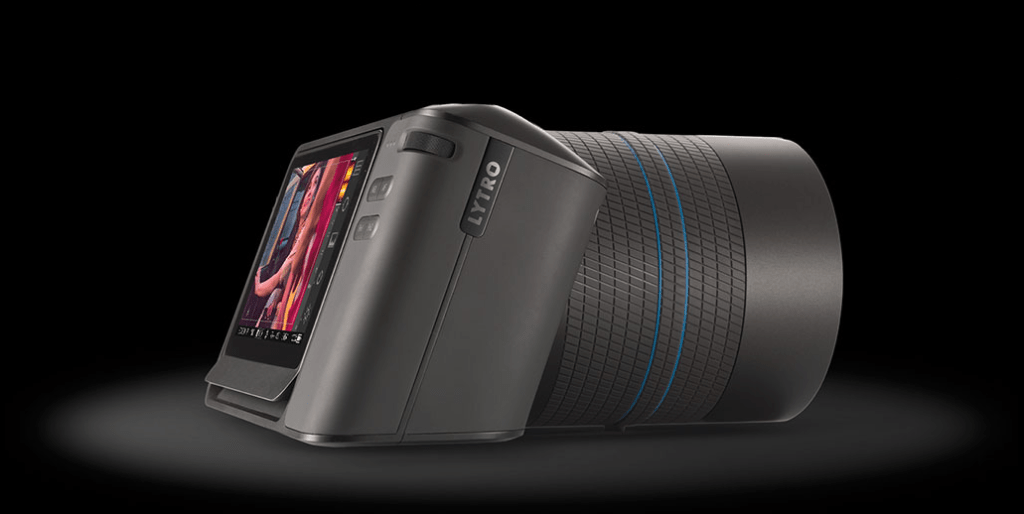
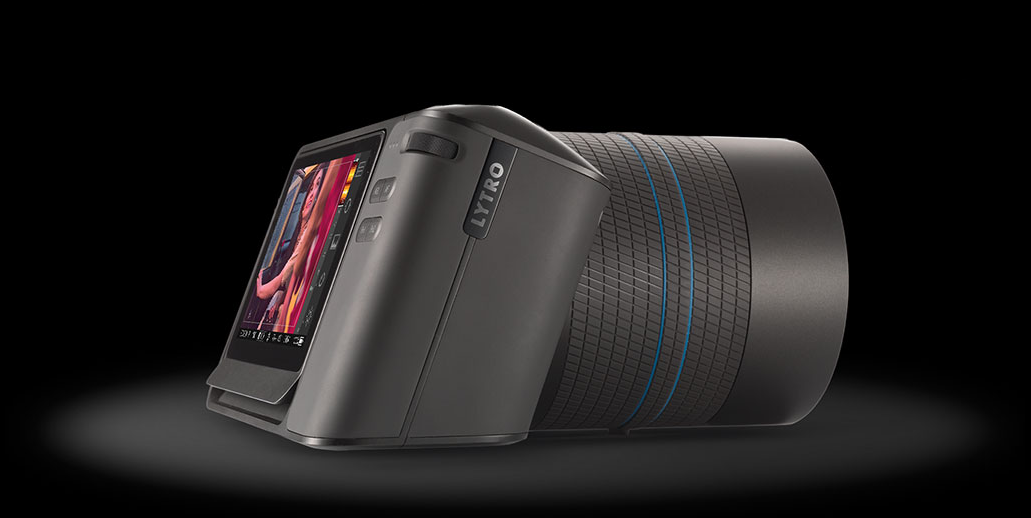
The Lytro Illum (2014)
What is it?
The Illum is a second-generation “light-field” camera to be released in 2014. It has been developed by Lytro – a company established in 2006. Their first eponymous device was released in 2011. The original device was highly portable and was designed in order to appeal to consumers – (despite retailing at around £400). The first-generation device took the form of an elongated square tube – with a lens on one-end and a touchscreen interface at the rear.
Through unique technology within the device – a sensor with plenoptic components (essentially an array of smaller lenses around the sensor) – the camera allows users to capture the entire “depth of field” contained within the image. This was previously impossible using traditional cameras (without taking a number of identical images simultaneously, using different focal lengths).
As a consequence of this, the “image” that was produced by the camera was characteristic, in that it is interactive – allowing the user to shift and “explore” the image by changing the point of focus of the image. This is championed by Lytro as a “living image” – and that there is a greater immersion in the experience of viewing (not-so?) static images. In addition to being able to alter the focal-point of images during viewership – a later hardware update added a degree of “perspective shift” where the user is able to shift the viewing of the image angle by a small degree. This is a significant functions – albeit limited by the fundamental nature of capturing though a single lens (or “eye”).
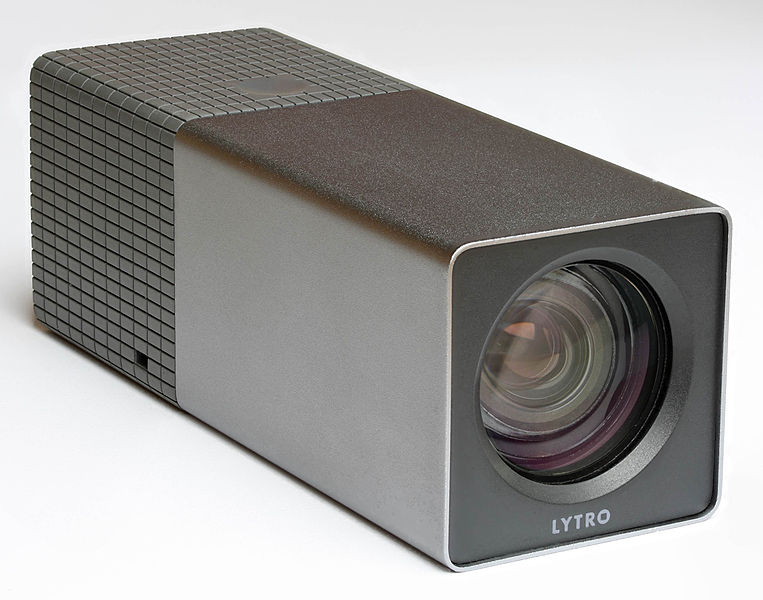
The Lytro (2011)
A number of Lytro “living pictures” can be seen and explored here.
The Lytro Illum, is the second generation iteration of this first device – but has been explicitly targeted towards professionals, both through its build (which is familiar as an “SLR” type camera) as well as its price-point (around £890) and proposed capabilities. The camera harbours some unique technical capabilities including a constant f/2.0 aperture (which allows it to both record light well in low-light scenarios – as well as critically capture a higher range of light information).
Why is it important?
The Lytro camera (and its second generation model the Illum) can be considered an important innovation in photographic technology and practice for a couple of reasons:
“Total Photography”
Firstly, it is a technological leap toward “light-field” photography – where instead of selecting a focal point within an image (or scenario) – the photographer is able to capture with clarity the totality of a situation or event within the frame. Within photographic cultures up until this point, we see many images focusing on a unique subject placed within the frame (and depth of field). This may be a consequence of the limitations of photographic technology to previously capture precise information about the totality of the scene. If widely adopted, this technology may alter the way that we record our experiences – from a highly selective exercise, to one that is more all-encompassing.
Interactive Viewship
In it’s consumption, photography is notable today (among new-media) in its non-interactivity. Typically, the audience simply looks at the visual information contained within the image and then subjectively constructs its meaning (through experience, association etc). A range of interactivity does occur in photography today – but largely through image-sharing, likes, comments, memes etc. Despite all of this activity, the content of the image remains stable, and unaffected by the audience.
Whilst the Lytro does not change this dramatically, it does make the act of viewing an image interactive – where the viewer is invited to shift the perspective and focus within the image as a means to explore its content. This kind of “interactive viewership” is something that may become increasingly prominent, with a range of other technologies poised to impact the way in which we consume visual media (particularly VR technologies such as Oculus Rift).
Promotional Video for the Lytro Illum
How might this impact the social camera?
The impact of the original Lytro camera has been relatively limited at this time – leading to refinement and the development of the second generation device. This reaction may have been for a number of reasons. I believe that there are two primary issues that the Lytro (and its predecessor the Illum) has to contend with in order to impact upon existing social-sharing practices:
The Issue of Uniqueness
At this point in time – the Lytro is a largely unique device, and crucially the “images” which the devices capture are a unique technology in their own right. This can be problematic. Firstly, in that it may not be immediately clear to audiences how to engage with Lytro images. Whilst it is fascinating to explore them – it could be argued that they cannot be “judged” on the same criteria of beauty as traditional “flat” compositions – as these have been constructed as a consequence of the limitations of “flat” photographic technology. The extent to which there is a difference in the appreciation of these “living images” on the Lytro network is something that I will look to explore in the future.
Secondly, there is a distinct issue with the technology of a Lytro image – in that being non-fixed it exists as a “plug-in” when embedded into webpages – and is in a sense never finalized or complete. Whilst this is a feature of the technology that is unique and inviting to users – it may also be an issue to their conventional enjoyment of photography (how can we discuss or praise an image if we are seeing two different things?) Despite this, the technology is at a very early stage – and the extent to which it is adopted and begins to become normalized (both culturally and technologically) remains to be seen. However, as previously stated, immerse technologies such as Oculus Rift VR show promising signs in relation to the acceptance of “3D” imagery.
Social Connectivity
Today the camera is a distinctly social device – not only allowing people to connect remotely to each other (and in the moment they are experiencing), but also at a technological level – through the inter-connectivity of applications and file types. These allow users to process and share images in a limitless number of ways – which has begun to define the kinds of practices and cultures that are associated with photography.
As a consequence, closed networks may suffer from being exclusive to this inter-connectivity – both in terms of users not being able to distribute Lytro images across other networks (as the images are a unique technology) but also from the fact that a Lytro image has no precedent as a cultural artefact (it is non-static, it cannot be printed – how do we share a “living image”). These are ideas I will continue to think about and explore.
Lytro Illum
As a consequence of these considerations however, I believe that Lytro is correct in that it does not position itself as a photography company. It is difficult for them at this time to be able to transform the social and technical nature of photography from within an increasingly tangled network – and one in which they can be considered entirely alien. Instead – the company should (and is) evangelizing the device as a completely new way of recording and exploring visual documents of the past.
![012. [Technology, Infrastructure, Process] Lytro Light-Field Photography Web Player Goes Open Source | THE SOCIAL CAMERA Avatar](https://martindouglashendry.com/wp-content/uploads/2024/12/ztvy8euyrzcuhfy1gp4g_wlwcia63bu0bc3bj.webp?w=40)
 Martin Douglas Hendry
Leave a comment